Do dogs laugh?
Last night I found myself typing a ridiculous question into an AI chatbot at 9pm: "Do dogs laugh?"
It's not an important question. I wasn't going to Google it. I definitely wasn't going to drive to a library or corner a vet at a barbecue. Before AI, that question would have surfaced, floated around for about four seconds, and dissolved. The curiosity was real, it just wasn't strong enough to survive the friction of finding an answer.

That's the thought I can't shake: maybe we never lost our childlike curiosity at all. Maybe we just lost permission to keep asking.
The questions don't stop. The asking does.
There's a well-known figure floating around that young children ask their parents somewhere around 100 questions a day. Whatever the exact number, anyone who has spent an afternoon with a four-year-old knows the shape of it. Why is the sky blue. Why do we have bones. Why is that man's face like that. (Yes, in the supermarket queue.)
Then they start school, and something changes.
Developmental psychologist Susan Engel spent months observing primary classrooms in the US, expecting to compare which children were more curious and which classrooms encouraged it most. She couldn't run the comparison. There simply wasn't enough curiosity to measure. She described the rate across the classrooms she visited as "astonishingly low."
The numbers are sobering. Engel and her team counted "curiosity episodes" — a question asked, an object investigated, a sustained curious gaze. In kindergarten classrooms, they averaged around 2.4 episodes per two-hour block. By Year 5 equivalent, that had dropped to around 0.5. In one classroom, two full hours passed without a single child asking a question.
Engel's point isn't that children stop being curious. It's that they learn, quite reasonably, that wondering out loud is expensive. It interrupts. It slows the lesson. It risks looking like you weren't listening, or that you're the only one who didn't get it. The response to a genuine question is often a quick answer and a redirect back to the plan — and children are excellent readers of what we actually reward.
So the curiosity doesn't die. It goes underground. It becomes the question you think of and don't ask.
What the AI data actually says about us
Here's where it gets interesting for us as educators.
In September 2025, researchers from OpenAI, Harvard and Duke published the largest study to date of how people actually use ChatGPT, analysing a representative sample of consumer conversations. If you assumed most of it was people writing emails and debugging code, the findings are a genuine surprise.
Non-work conversations made up over 70% of all usage, up from 53% a year earlier. Computer programming accounted for only about 4% of messages. And the three largest categories — Practical Guidance (things like how-to advice and tutoring), Seeking Information (facts about people, events, products, recipes), and Writing — together made up roughly three-quarters of everything.
The researchers also sorted usage into "Asking," "Doing," and "Expressing." Asking — using the model as an advisor or explainer rather than a task-completer — was the single biggest bucket at around 49% of messages, and users rated it more highly than task completion.
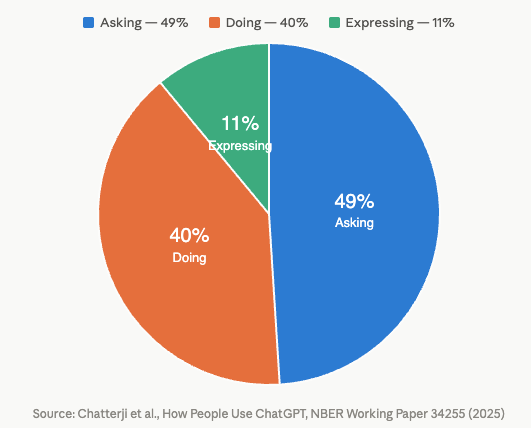
Distribution of Message Types received by ChatGPT
Roughly half of humanity's interaction with the most sophisticated technology we've ever built is: explain this to me.
Not "do my job." Not "write my novel." Just — what is this, why does it work like that, help me understand.
That is not a productivity story. That's a story about a species that never stopped wanting to know things, finally finding somewhere it could ask without cost.
Why this matters for teachers
Two things follow, and I think the second is the more important one.
First: the friction was never the point. We sometimes tell ourselves that making students work hard for an answer is what makes the learning stick. There's real truth in that — effortful retrieval is genuinely powerful. But there's a difference between productive struggle inside a question a student cares about, and the flat administrative cost of asking in the first place. Engel's classrooms weren't full of students grappling productively. They were full of students who had quietly concluded that asking wasn't worth it. That's not desirable difficulty. That's just a closed door.
Second, and this is the invitation: go and be curious yourself, using AI, and pay attention to how it feels.
Not as professional development. Not to write a unit plan. Ask it something genuinely useless to your job. Why does my dog do that. How does a heat pump actually cool a room. Why is the Waikato River that colour. What's the deal with the moon looking bigger near the horizon.
Then notice three things:
How good it feels to have the question taken seriously. Nobody sighed. Nobody said "we'll come back to that." That feeling is exactly what a five-year-old is chasing when they tug your sleeve for the ninth time.
How quickly one question becomes four. You'll ask a follow-up. Then a follow-up to the follow-up. This is the natural shape of curiosity, and it is precisely the shape we most often interrupt in our classrooms — because we have a lesson to get through, and fair enough.
How much you didn't know that you didn't know. Sitting in the position of not-knowing, voluntarily, is a muscle most of us stopped using around the time we became the person at the front of the room who is supposed to know.
That third one is the real gift. It's very hard to sustain patience with a child's endless "but why" if you haven't recently been that person yourself. Using AI to feed your own dormant curiosity isn't a detour from your practice — it's the fastest empathy exercise I know for remembering what it's like to be on the other side of the question.
Small things to try this term
Keep a Wonder Wall, and actually return to it. The point isn't the sticky notes. It's the visible signal that a question you can't answer right now is not a question that gets thrown away.
Swap "we don't have time for that" for "let's park that and find out." Same time constraint, opposite message.
Model not-knowing out loud. "I actually don't know. I'm curious now too." Engel's related work found that when teachers visibly express curiosity, children explore more. You are the weather in that room.
Let students use AI to chase a tangent, then bring it back to the group. The tangent isn't the enemy of the lesson. Ten years from now they won't remember the lesson; they might remember that a question of theirs was worth following.
Ask one useless question a day yourself. Genuinely. Set a reminder if you have to.
The door was never locked
If the thesis holds — that the curiosity was always there, waiting on the other side of a cost we stopped being willing to pay — then AI hasn't given us anything new. It's just made the cost approximately zero, and revealed what was underneath the whole time.
Which raises a question worth sitting with as teachers: how much of the incuriosity we see in front of us every day is actually incuriosity, and how much of it is just a room where asking has become too expensive?
Sources
Engel, S. (2011). Children's Need to Know: Curiosity in Schools. Harvard Educational Review, 81(4), 625–645.
Engel, S. (2015). The Hungry Mind: The Origins of Curiosity in Childhood. Harvard University Press.
Chatterji, A., Cunningham, T., Deming, D., Hitzig, Z., Ong, C., Shan, C., & Wadman, K. (2025). How People Use ChatGPT. NBER Working Paper 34255. https://www.nber.org/papers/w34255
Berger, W. (2014). A More Beautiful Question. Bloomsbury.